How to Choose AGV Technology for Your Warehouse in 2026?
Choosing Agv Technology in 2026 is no longer a simple equipment purchase. It is a warehouse design decision involving traffic, labor, software, safety, and return on investment. A vehicle that performs well in a quiet storage zone may struggle near packing stations, forklifts, and constantly changing pallets.
Industry data shows why this decision deserves careful analysis. The International Federation of Robotics reported that transportation and logistics robots represented the largest professional service robot category in 2023, with approximately 113,000 units sold worldwide in its World Robotics 2024 report. The 2024 MHI Annual Industry Report also found that 43% of supply chain professionals were already using robotics and automation, while many more planned investments within five years. These figures indicate strong momentum, not automatic success.
A practical evaluation should begin with the warehouse floor. Measure aisle width, travel distance, floor condition, rack height, pallet weight, and hourly order volume. Then compare navigation methods, charging routines, fleet management software, integration options, and operator training. For example, a pallet AGV moving 1,000 kilograms through a fixed route needs different controls from a cart-towing vehicle serving flexible picking zones.
The wrong choice remains expensive.
Experience matters here. Vendor demonstrations often use clean floors and ideal traffic, while real sites contain delays, blocked aisles, and uneven work patterns. No selection model is perfect. Therefore, pilot testing, transparent performance data, and independent safety assessments should guide the final decision. A scalable system should solve today’s bottleneck without creating tomorrow’s maintenance burden.
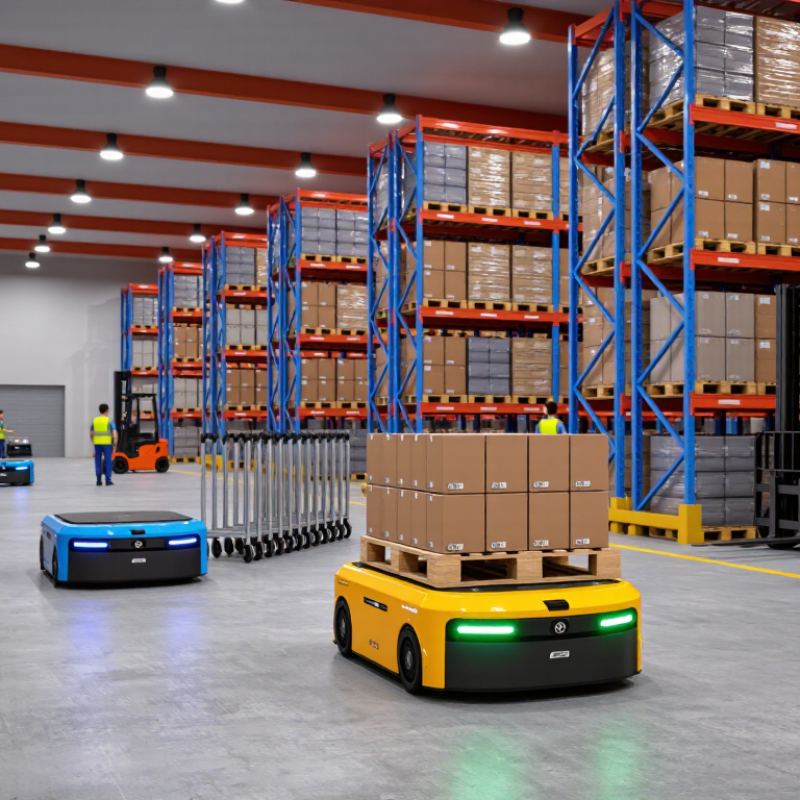
Define Warehouse Requirements and Material-Handling Goals
Before selecting AGV technology, define what your warehouse must accomplish each day. Measure inbound volume, order lines, travel distances, load weights, pallet sizes, and peak-hour demand. Record aisle widths, floor conditions, slopes, doorways, and charging locations. Do not rely on layout drawings alone. Walk the facility during its busiest shift.
Small errors matter. Speak with operators, supervisors, maintenance staff, and inventory planners. They often know where pallets wait, labels become difficult to scan, or traffic suddenly slows.
Then translate these observations into measurable material-handling goals. You may want fewer manual transfers, shorter replenishment times, better inventory accuracy, or safer movement near pedestrian zones. Each goal needs a baseline and a target.
Match the technology to real work patterns, not impressive specifications. A vehicle carrying light cartons may need different navigation and loading features than one moving heavy pallets. Check payload stability, turning space, route flexibility, obstacle detection, battery performance, and system integration requirements. A small pilot can test these points during normal operations. It may expose overlooked bottlenecks. Good planning also accepts imperfect data. Some cycle-time records may be incomplete, and demand forecasts may change. Document assumptions, test them, and revise the requirements before making a major investment.
Compare AGV Types, Navigation Systems, and Load Capacities
How to Choose AGV Technology for Your Warehouse in 2026?
AGV selection should begin with load behavior, not fashionable features. Tugger AGVs suit repeated trailer or cart routes. Unit-load models handle cartons and totes between workstations. Pallet AGVs need stable forks, clear pallet openings, and accurate stopping. Forklift-style AGVs support heavier loads, but require wider aisles and stronger floor conditions. The International Federation of Robotics reported about 113,000 professional transport and logistics robots sold in 2023. That growth shows demand, not automatic suitability.
Navigation affects both reliability and layout freedom. Magnetic tape and QR markers offer predictable routes and simple maintenance. Laser navigation supports mapped aisles and changing stations. Vision or SLAM-based systems can reduce infrastructure, but dust, glare, and shifting pallets may reduce accuracy. Fixed-route AGVs often provide better repeatability. More flexible systems may need stronger traffic management. This trade-off is easy to underestimate.
Tips: Record payload weight, dimensions, center of gravity, aisle width, floor gaps, and peak traffic for two weeks. Compare rated capacity with the heaviest real load, not the average. A 1,000-kilogram rating may not fit a tall, unstable pallet. Check battery runtime, charging method, recovery procedures, and integration with warehouse software. MHI’s 2024 industry report found that 67% of supply-chain professionals expected to adopt robotics or automation within one to two years. Still, a pilot can fail. That is useful. Review missed stops, blocked routes, and operator interventions before scaling. Data from your own site should outrank a polished demonstration.
How to Choose AGV Technology for Your Warehouse in 2026?
Typical payload ranges vary by AGV type. Laser-based navigation is widely used for flexible routes, magnetic or QR guidance suits structured layouts, and natural-feature navigation supports dynamic warehouse environments.
Indicative industry ranges in kilograms. Actual capacity depends on vehicle configuration, floor conditions, safety requirements, load dimensions, and operating speed.
Assess Software, Safety, and Integration Requirements
How to Choose AGV Technology for Your Warehouse in 2026?
AGV selection should begin with software, not vehicle speed. Your fleet manager must exchange live orders with the WMS or WES through stable APIs. It should also manage traffic, charging, exceptions, and manual recovery. MHI’s 2024 Annual Industry Report found that 55% of supply chain professionals were increasing technology investment. That investment can fail when software ownership remains unclear. Ask who will maintain integrations after launch.
Safety requires evidence, not attractive demonstrations. ISO 3691-4:2023 provides safety requirements for driverless industrial trucks, including AGVs. Request risk assessments, speed controls, protective fields, emergency stops, and pedestrian separation. Test a worker crossing the route with a loaded cart. Test a blocked aisle. Test failure recovery. Safety comes first. Incomplete testing is still a risk.
Integration details often decide the project’s real cost. Confirm barcode accuracy, elevator signals, fire-door interfaces, charging locations, and network coverage. Use sandbox data before connecting live orders. The International Federation of Robotics reported 4.28 million industrial robots operating worldwide in 2023, a 10% increase from 2022. That figure does not directly measure warehouse AGVs, but it signals growing automation complexity. A small pilot may expose problems that a larger rollout hides. Measure completed missions, near misses, recovery time, and operator workload. Do not trust one impressive demo.
Calculate Total Ownership Costs and Expected Operational Benefits
How to Choose AGV Technology for Your Warehouse in 2026?
Total ownership cost begins before the first AGV moves. Build a five-year model, not a purchase-price comparison. Include vehicles, charging equipment, mapping, software, integration, training, maintenance, spare parts, energy, and downtime. MHI’s 2024 Annual Industry Report found that 55% of supply chain leaders planned to increase technology investment. That investment still needs measurable returns.
Calculate benefits from real operating data. Multiply eliminated labor hours by fully loaded wages. Add fewer picking errors, shorter travel distances, higher throughput, and safer handling. Then subtract new supervision and maintenance costs. For example, saving 1,200 labor hours monthly at 22 dollars per hour creates 316,800 dollars in annual gross savings. The math is unforgiving. A spreadsheet can still lie.
Test several scenarios, including low volume, seasonal peaks, and equipment failure. A 2023 industry warehouse study reported that 69% of decision-makers expected greater automation adoption within two years. That trend supports investment, but it does not guarantee payback. Measure charging queues, aisle congestion, mission delays, and manual interventions during a pilot. A realistic model should include productivity loss during installation. It should also price floor repairs, network upgrades, and employee retraining. The cheapest AGV may produce the highest five-year cost. Recheck every assumption with shift supervisors and maintenance technicians.